Tuesday, 10 February 2015

Evaluation Question 4

What have you learned from your audience feedback?

During the editing stages, the audience feedback we received was mixed. At the beginning, we had an idea to add in the Queen of Hearts as well. This was changes as we chose to film at night and the footage was not of a very high quality/standard therefore, due to overall imagery and mixed feedback, we decided to get rid of this part. 
This was quite hard as we were two days pre-deadline and didn't have any other footage to cover another essential/crucial two minutes of the music video. Again, this was something we pulled through as a group and chose to add in the intro, when Alice falls asleep, as well as the end, when she wakes up.

This clearly made the audience feedback immediately more positive as we shot this during the day therefore the lighting and quality was much better, and also, it turned out that it suited better with the story line.
Below are a few videos of audience feedback after the music video.


The ancillary products received attention as well. I went on a website; 
and got the following feedback:


I also then filmed the reaction we got immediately after the music video had ended:


Monday, 9 February 2015

Evaluation Question 3

How did you use media technologies in the construction and research, planning and evaluation stages?

In these stages, we used social media a great deal by this point. Our instagram page was used to update our teachers on our progress.


This is the artists' instagram. The name is 'liza__dasilva'. We have a picture of Alice and every character shown in the music video in order to keep the audience's view consistent. 


This is some of the brand new state of the art equipment that we used. 


We decided to use a DSLR Camera as it was the camera with the best quality whilst the lens was changed, as well as a better camera overall for our music video than the video camera.
We also used to fig rig for stability as we needed to move the camera around a great deal during filming.
Other equipment includes the mini speaker so that the artist could hear the music whilst lip syncing so that it looked much more realistic. 
Before initially shooting, we did a mini tutorial at which the artist had to lip sync a song given to us by the teacher. This production was planned entirely differently to my AS production. It entailed much more thorough research as well as was more hard work owing to the artist having to lip sync in sync with the song. Lip syncing was the hardest part as I was chosen to be the artist. Lip syncing wasn't needed last year as we just shot the opening to a film. This only meant that we had to act, aswell as edit to a beat. This year, we had to make sure that not only did we edit to the beat, but that we had enough shots to edit owing to the location we chose. This was exceptionally hard as myself and my group all live quite far away from eachother, and a significant distance away from our chosen location; Alexandra Palace. This meant that we had to film very precisely and plan more cautiously, especially when it came to shots and outfits. Even our hair had to be exactly the same as if it wasn't, we wouldn't be able to thoroughly edit the shots in order for them to look like they were shot at the same time on the same day. This wasn't needed last year as we had less to fit into the project meaning more time to film when we didn't have the right shots etc...


For editing, in Final Cut Pro, we changed a few features throughout such as making everything black and white when the artist said black and white etc. 


This is all made evident within the ancillary work as well as the posters, for example, entail the same colours, fonts and technology as the video. In addition, the social media is included as well.


Evaluation Question 2

How effective is the combination of your main product (video) and ancillary texts (digipak and advertisement)?

The main aspect of the video and ancillary products being effective is keeping this like the fonts, colour pallettes, and outset from the beginning consistent. I made sure of this as I want a member of the target audience to see one type of product whether it is the main products or the ancillary texts and understand/subconsciously remember where they'd seen it before.

A good example to portray how I was inspired to keep everything throughout consistent would be 'Daft Punk's' music video and CD Cover. The colour pallette remains the same (golds, silvers, whites and blacks) throughout each and every product.


The CD Cover (left) and the poster (right) both entail the same colours as well as the same image. The image of which is a merge of two astronaut type helmets, sets the theme for the music video as well. This allows for a consistence scheme of events, as well as a successful approach at synergy.


The helmets are also featured in the video.


My products entail the same principles:


Powered by emaze

Sunday, 8 February 2015

Evaluation Question 1

In what ways does your media products use, develop or challenge forms and conventions of real media products?

My media product uses, develops and challenges forms of conventions of real life media products in many ways. My media products use conventions of real life media products through out, such as the use of male gaze (a theory by Laura Mulvey; http://www.slideshare.net/beccacobb/laura-mulvey-the-male-gaze) in certain parts of the music video. The male gaze idea was solely influenced by Rihanna's 'Only girl in the world'. Rihanna is generally an artist that abides by the male gaze in order to gain an audience through the way that she looks.
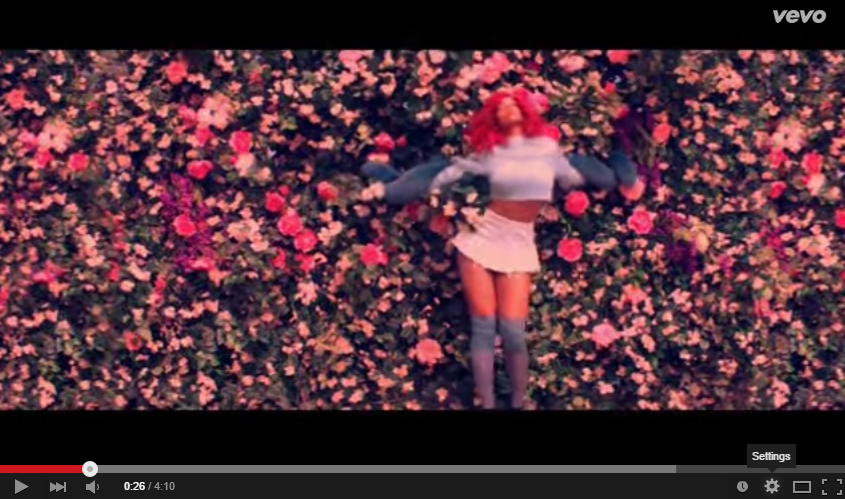
For example, in order to distinguish the change/difference between the chorus and the verses, our artist twirls around to the slow beat of the song at that moment and a mid shot is used to shoot the whole of her body. This indicates male gaze, as shown below.


This is also evident within Rihanna's music video right from the beginning.


My media product challenges forms and conventions of real media products as there isn't often the idea of an old tale involved within a music video. Usually, a music video consists of an artist lip syncing with a story line to do with a mainstream subject that sells such as love or money. My music video focusses more on an old tale (Alice in Wonderland). This was the main focus owing to most of the world knowing about the story therefore attracting a wider audience, but most importantly attracting our target audience. 

Other media products of which use/develop forms and conventions of real media products include my ancillary work. My poster, for example, continues on with the theme of male gaze as it is a picture of the artist and her body whilst wearing a small top. 


Friday, 30 January 2015

The inside of my CD cover


I began with the exact same list from the back cover, which contains the same font and colour palettes, in order to keep the theme of the CD Cover consistent through the use of the same reds, blues, whites and blacks. 


I then added the record labels (without the barcode) and where the description states that "All Rights Are Reserved" in order to again, keep the layout and aspects that I used the same.


After, I felt it was essential to add the 'credits' of who was responsible for editing, producing  and directing the product etc.


In addition, I made it personal by adding a special thanks message from the artists of which is 'signed' underneath. This will enable the audience who listens to the CD to empathise with the artist more. 


The back of the CD Cover consists of pictures of the artist in blues and reds mirroring each other. I decided to keep this theme consistent and add this on the back as well, but with a picture of the artist facing the other way.


This is the end result! 

Friday, 23 January 2015

Evaluation Question 4

 What have you learned from your audience feedback?


Watching the feedback we got from our rough cut, some said that the editing technique of the ' special effect ' that we create at the beginning of the song and at the end of the song. Another feedback we had from our rough cut is that they said we really focused on the costume that helps with the story telling in the music video.

Improvements that needed to be done; was really focus with the lip-syncing that matches with the song, another one was that our weak point was at the end, the last chorus.

Changes we made from the rough-cut feedback is that we top notch the lip syncing. We cut out the last chorus of the song along with the video so we won't have a weak spot in our music video.


At the cinema screen, I'm really please that we made major changes from the rough-cut feedback. It really did made big differences to our main product. If we didn’t make any changes at all, it would of make the Music Video look very weak at the end and it will put all hype from the beginning till half way.


I recorded a audio only for my audience feedback for the ancillary that I produced. Reflecting on the ancillary work, I kept it simple along with the Advertisement, keeping these two both very similar to each other to link with the synergy rather than having one completely different from the other. Otherwise it wouldn’t work. If there no connection between the two, it would be a real media product.  

Evaluation Question 3

How did you use media technologies in the construction and research, planning and evaluation stages?

I'll be breaking this question into stages from the beginning of production to end of production.

Research:


Before we could begin to film our music video, I had to research on what the conventions of a music video are in general and within our genre. For this I had used blogger to keep track all of our research that I had found and found multiple music videos on Youtube to support our findings and points. 

This were two theory that we had to researched about and it was Carol Vernallis and Muvley

Lip Syncing:

After doing some researching by using the internet, we then went into a testing for our lip syncing skills before filming the actual music video. 

This is our 50 second Music video that we have to produce to see how much we know about lip syncing.


The improvements that I wish I could do is that if we had more time to produce this 50 sec MV, but other than that, I think we done a pretty good job with the time we had to film this 50 second MV


Researching more about our Music Video:

After we had finished our lip sync practical and was pleased with the outcome. We then started thinking of our own music video, as a group we had to research and blog about everything we planned to involve within our music video, this included things such as, what equipment we will be using, location, concept, costume, props, synergy, our target audience, social media that we would plan use, draft digipaks, storyboards, a production schedule that we will plan to stick to and more. Whilst making all this research we would use applications such as prezi and slideshare so it was a lot clearer to present our information.


Pre-production:

Storyboard was needed for our production. 

Page 1


Page 2


Page 3


Page 4


After making a storyboard, we then made a production schedule on Timetoast.


Production:

Equipments that we used for our production.

  We used a DSLR rather than a Film camera as we all agree to use a DSLR as I explained why we should use one. A DSLR is able to change settings that can make the filming or Music Video at a high quality. The college provided us with this DSLR and in addition, they change the lens for it which means better zoom-in, better focus and better quality than the Film camera. 

We wanted to make sure that DSLR filming settings was suitable for final cut pro, we done a little film testing with the DSLR.


A Figrig for stabilisation while filming.


Mini Speakers to listen to the sound track during production, that we picked out and for the artist to lip sync the lyrics.


During Production, we wanted to keep up to date with the audience, so we took some sneak peak images for audience to stay in touch with us. 


Editing:

Right after filming all our footages that we needed during production, we then headed to the editing suite where we can edit our Music Video. We used Macs as Final Cut pro is only available on macs. During Post-production, we downloaded the sound track and added to the timeline, after that we added the footages on the timeline where want them to be. 
This will be a standard draft where all the footage is on the timeline. After being happy where all the footage is, we then edited by cutting the footages precisely.
Took 3 weeks ( 4.5 hours per week ) to have the final draft finished. After showing it to the class, we then recorded a feedback from the class for the draft before actually finishing the editing. 


Ancillary: 

After finishing the editing, we then headed to creating/producing our Digipak and Advertisement for our brand new artist. We all used Photoshop with a template to guide our way making the Digipak. In every creation or producing, we had to do some research with real products that has been released to get inspired by or to look at as a guidance.